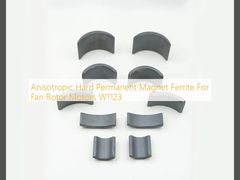
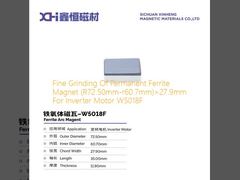
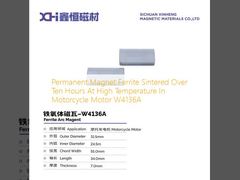
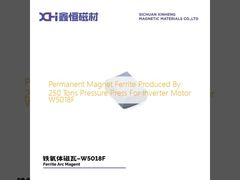
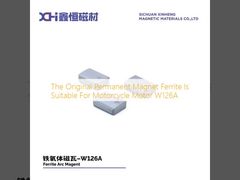
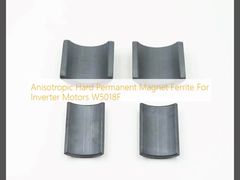
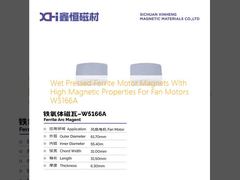
Brief: We tested it—see the highlights and what to expect in real operation. This video provides a detailed walkthrough of the Rectangular Sintered Ferrite Magnet W4029K, showcasing its manufacturing process, key magnetic properties, and real-world performance in motorcycle starter motors. You'll learn how its anisotropic structure and wet compression molding deliver reliable engine starts and consistent operation.
Related Product Features:
Manufactured using anisotropic ceramic strontium ferrite via wet compression molding for consistent magnetic orientation.
Contains strontium ferrite (SrFe12O19) as the primary magnetic material, offering good magnetic properties at low cost.
Achieves high relative density of around 95% or more after sintering, providing excellent mechanical strength.
Exhibits strong magnetocrystalline anisotropy due to hexagonal crystal structure, ensuring preferred magnetization direction.
Offers medium to high coercivity depending on additives, density, and achieved anisotropy level.
Maintains good magnetic properties over a wide operating temperature range with high Curie temperatures of 450-470°C.
Provides dimensional consistency and uniform shapes through precision compression molding for mass production.
Resistant to corrosion as a fully dense ceramic material, ensuring long-term reliability in motorcycle motors.
FAQs:
Was ist die Hauptanwendung des rechteckigen gesinterten Ferritmagneten W4029K?
Dieser Magnet wurde speziell für den Einsatz in Motorradmotoren entwickelt, insbesondere in Anlassermotoren, wo er die notwendige Magnetfeldstärke für zuverlässige und effiziente Motorstarts liefert.
Welchen Nutzen hat das Nasspressverfahren für diese Ferritmagnete?
Das Nasspressverfahren ermöglicht die konsequente Herstellung enger Maßtoleranzen und einheitlicher Magnetformen. Es richtet die anisotropen Partikel während des Formens und Sinterns aus, was zu hohen magnetischen Eigenschaften und einer Massenproduktionsfähigkeit führt.
In welchem Temperaturbereich können diese gesinterten Ferritmagnete betrieben werden?
Diese Magnete haben eine maximale Betriebstemperatur von 350 °C und eine Curie-Temperatur von 450 °C.mit einer Temperaturstabilität von mehr als 20 °C,.
Was sind die wichtigsten magnetischen Eigenschaften der Ferrit-Pulversorten, die für Motorradmagnete verwendet werden?
Die Ferritpulversorten reichen von Y33 bis Y40, mit einer Remanenz (Br) von 410-460 mT, einer Koerzitivfeldstärke (Hcb) von 200-354 kA/m und einem maximalen Energieprodukt ((BH)max) von 31,5-41,8 kJ/m³, wodurch verschiedene Leistungsniveaus für unterschiedliche Motoranforderungen bereitgestellt werden.